How To Have Fun With Fido
by Karen Lee Stevens.
This originally appeared in the South Coast Beacon.
 There's no doubt about it--I'm a party animal. So, when I opened my mail the other day and found an invitation to Santa Barbara Pug Rescue's annual Pug Party, I yipped in excitement. A party with dogs and a cake? It just doesn't get any better than that. But, I can tell you right now, you're not going to find me making small talk and nibbling on the broccoli and celery sticks for long. I'm going to be right in the middle of the action with a digital camera in one hand and a notebook in the other. Karen Lee Stevens, Cub Reporter.
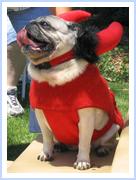
From the moment I stepped through the gates of Connie Phillip's County English estate on the Riviera, I was surrounded by a plethora of pampered pugs. There was nary a bark nor a bite among these squishy-faced, curly-tailed cuties. There were pugs puckering up in hopes of winning the Best Kisser contest, while others preened about in lavish attire in anticipation of taking home the blue ribbon for Best Costume. Those too pooped to party could be found cooling their paws in a shaded play pen.
My favorite pug though had to be four-year-old Molly, a paraplegic pug who belongs to Mandy Evans of Santa Barbara. Molly doesn't let her handicap slow her down. This sweet and friendly four-year-old pug propels herself around with her very own custom-made set of wheels. Evans frequently takes Molly into local schools to talk about what it's like to love and care for a dog with special needs.
The pawpularity of pooch parties are increasing exponentially, according to the American Pet Products Manufacturers Association. The findings showed that, in 2004, nine percent of dog lovers held birthday parties for their canines, a six-fold increase over the previous year.
No one knows how to party with panache better than Arden Moore, author of Dog Parties: How to Party with Your Pup. She says, "Wouldn't you rather attend a dog party than a snobby wine-tasting affair, a pricey candle party, or a put-you-to-sleep Monopoly marathon? People parties are passé--dog parties rule!"
I couldn't agree more. My recent foray into dog party-dom was absolutely pugalicious and I can't wait for another one. Pawty on!
This originally appeared in the South Coast Beacon.
 There's no doubt about it--I'm a party animal. So, when I opened my mail the other day and found an invitation to Santa Barbara Pug Rescue's annual Pug Party, I yipped in excitement. A party with dogs and a cake? It just doesn't get any better than that. But, I can tell you right now, you're not going to find me making small talk and nibbling on the broccoli and celery sticks for long. I'm going to be right in the middle of the action with a digital camera in one hand and a notebook in the other. Karen Lee Stevens, Cub Reporter.
From the moment I stepped through the gates of Connie Phillip's County English estate on the Riviera, I was surrounded by a plethora of pampered pugs. There was nary a bark nor a bite among these squishy-faced, curly-tailed cuties. There were pugs puckering up in hopes of winning the Best Kisser contest, while others preened about in lavish attire in anticipation of taking home the blue ribbon for Best Costume. Those too pooped to party could be found cooling their paws in a shaded play pen.
My favorite pug though had to be four-year-old Molly, a paraplegic pug who belongs to Mandy Evans of Santa Barbara. Molly doesn't let her handicap slow her down. This sweet and friendly four-year-old pug propels herself around with her very own custom-made set of wheels. Evans frequently takes Molly into local schools to talk about what it's like to love and care for a dog with special needs.
The pawpularity of pooch parties are increasing exponentially, according to the American Pet Products Manufacturers Association. The findings showed that, in 2004, nine percent of dog lovers held birthday parties for their canines, a six-fold increase over the previous year.
No one knows how to party with panache better than Arden Moore, author of Dog Parties: How to Party with Your Pup. She says, "Wouldn't you rather attend a dog party than a snobby wine-tasting affair, a pricey candle party, or a put-you-to-sleep Monopoly marathon? People parties are passé--dog parties rule!"
I couldn't agree more. My recent foray into dog party-dom was absolutely pugalicious and I can't wait for another one. Pawty on!
Karen Lee Stevens is the pet columnist for the Montecito Journal, published biweekly in Montecito, and is the founder and Executive Director of AllforAnimals.com.
posted by NewsstandGreg at 3:23 PM · permalink
Tag: del.icio.us,
Technorati,
Digg,
Furl
0 comments